
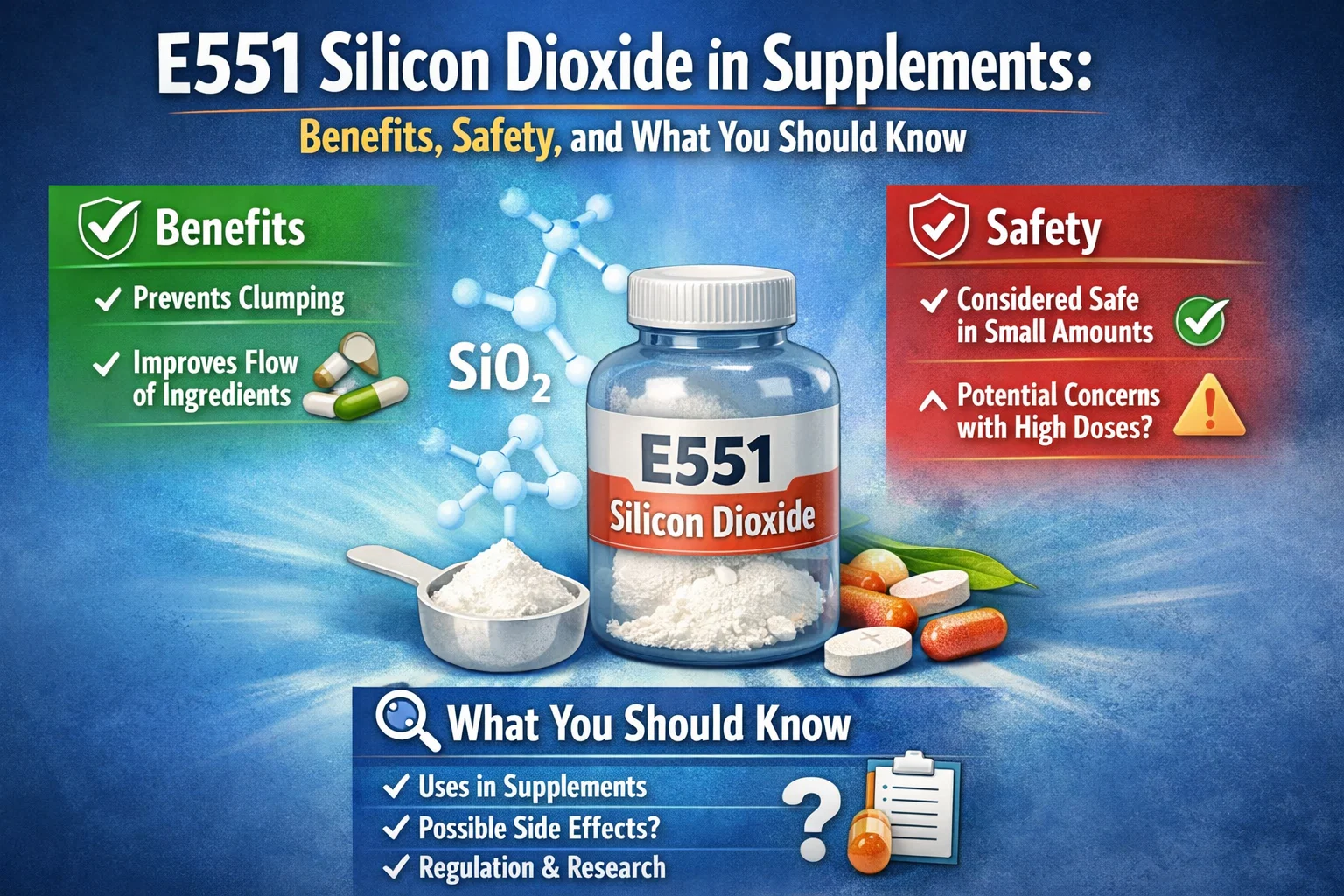
E551, Silicon Dioxide in Supplements: Benefits, Safety, and What You Should Know
Silicon dioxide, also known as silica, is a naturally occurring compound made of silicon and oxygen. It is one of the most widely used additives in dietary supplements, especially in powders and capsules. E551 In supplements or silicon dioxide is primarily added to improve flow, stability, and consistency, rather than for direct nutritional value.
You’ll commonly find silicon dioxide in pre-workouts, protein powders, multivitamins, mineral capsules, and herbal supplements.
Table of Contents
Chemical & Functional Overview
Silicon dioxide (SiO₂) exists naturally in sand, quartz, and many plant-based foods. In supplement manufacturing, it is used in a purified, food-grade form.
Key functional properties:
- Insoluble in water
- Chemically stable
- Heat resistant
- Non-reactive with active ingredients
Primary role in supplements:
👉 Anti-caking agent and flow enhancer
Why Silicon Dioxide in Supplements
Supplement manufacturers rely on silicon dioxide for several practical reasons:
- Prevents powder clumping caused by moisture
- Ensures smooth flow during capsule filling
- Improves dosing accuracy
- Extends shelf life
- Maintains product texture and consistency
Without anti-caking agents like silicon dioxide, many powdered supplements would harden, clump, or become difficult to mix.
Common Supplement Types That Contain It
Silicon dioxide is commonly found in:
- Pre-workout powders
- Protein powders
- BCAA & EAA supplements
- Multivitamins and mineral tablets
- Herbal capsules
- Electrolyte mixes
It is especially important in powder-based formulations.
Benefits for Consumers
Silicon dioxide, while not a source of vitamins or minerals, provides several practical and functional advantages that improve the quality of dietary supplements. Its primary role is as an anti-caking and flow agent, which ensures that powders, capsules, and tablets remain easy to use and consistent over time.
Key consumer benefits include:
- Better mixability in powders: Silicon dioxide prevents clumping, allowing protein powders, pre-workouts, and other supplements to mix smoothly in water or shakes. This ensures each serving has a uniform texture and flavor.
- Consistent dosing per scoop or capsule: By improving the flow of powders during manufacturing, it helps guarantee that each scoop or capsule contains the exact intended amount of active ingredients, which is essential for supplement effectiveness.
- Improved product stability: Silicon dioxide reduces moisture absorption and prevents ingredient separation, helping maintain the product’s quality throughout its shelf life.
- Reduced risk of moisture-related spoilage: By keeping powders dry and free-flowing, it minimizes the likelihood of mold growth or degradation caused by humidity.
Together, these benefits enhance the user experience by making supplements easier to measure, mix, and consume, while also ensuring the product performs as expected from the first scoop to the last.
Safety Profile & Regulatory Status
Silicon dioxide is widely regarded as safe for human consumption when used within regulated limits in dietary supplements and food products. Regulatory authorities around the world recognize its safety based on extensive research and toxicological evaluations.
Regulatory status includes:
- ✅ Approved by the FDA (USA) as a safe food additive.
- ✅ Approved by the EFSA (Europe) for use in foods and supplements.
- ✅ Classified as GRAS (Generally Recognized As Safe), indicating no known safety concerns when used at normal levels.
Because it is poorly absorbed by the body and largely excreted, there is no established Acceptable Daily Intake (ADI), and the risk of toxicity at typical supplement doses is extremely low.
Potential Side Effects & Controversies
At standard supplement doses, silicon dioxide is generally well tolerated and does not cause adverse effects. However, it is important to understand potential concerns:
- Extremely high doses may cause mild digestive discomfort, but such levels are rarely encountered in normal supplement use.
- Inhalation risk applies only to industrial dust forms of silica and is not relevant to food-grade or supplement-grade silicon dioxide.
Important clarification: Food-grade silicon dioxide, used in powders, capsules, and tablets, is chemically stable, non-toxic, and safe for daily consumption. Concerns that sometimes appear in online forums are usually related to industrial forms of silica, which are not used in dietary supplements.
Natural Silicon Dioxide vs Synthetic
Silicon dioxide can be sourced in two ways:
- Natural: Extracted from plant-based or mineral sources
- Synthetic: Manufactured for purity and consistency
Both forms are chemically identical and equally safe. “Natural” labeling does not necessarily mean superior quality.
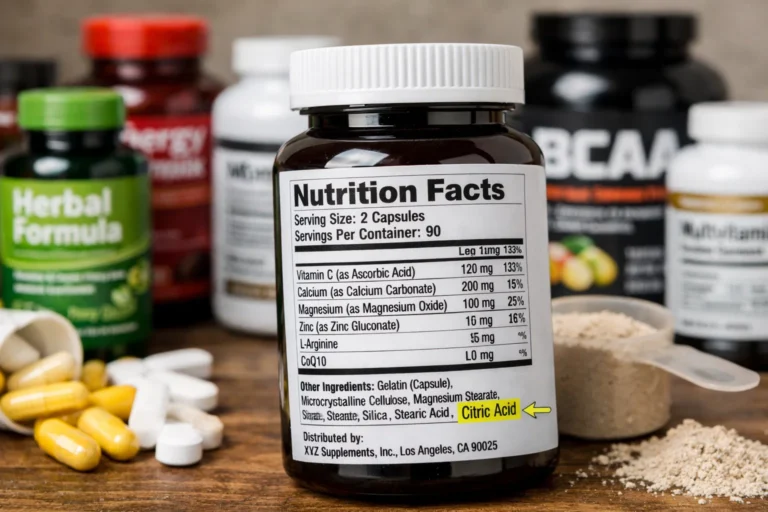
How to Identify Silicon Dioxide on Supplement Labels
Silicon dioxide may appear under several names:
- Silicon Dioxide
- Silica
- Silicon Oxide
- E551 (EU food additive code)
It is usually listed near the end of the ingredient list due to its low dosage.
Clean Label Perspective
Opinions on silicon dioxide vary among clean-label brands.
Accepted by many clean brands because:
- It is naturally occurring
- Used in very small amounts
- Improves product quality
Avoided by some brands because:
- It is considered a “processing aid”
- Not nutritionally active
Common alternatives:
- Rice hull concentrate
- Calcium silicate
Scientific Studies & Evidence
Scientific research shows that silicon dioxide:
- Is poorly absorbed and largely excreted
- Does not accumulate in the body
- Does not interfere with nutrient absorption
Multiple toxicological studies support its long-term safety at dietary levels.
Expert Opinion & Final Verdict
Expert assessment:
Silicon dioxide is a safe, functional, and widely accepted additive in dietary supplements. It plays a critical role in ensuring product consistency without posing health risks.
Overall score: ⭐⭐⭐⭐☆ (4/5)
✔ Safe
✔ Effective
✖ No nutritional benefit
FAQ – Frequently Asked Questions
Is silicon dioxide bad for health?
No. At supplement doses, it is considered safe by major health authorities.
Is silicon dioxide vegan?
Yes, silicon dioxide is 100% vegan.
Does silicon dioxide cause bloating?
Very unlikely at standard doses.
Is silicon dioxide natural?
It occurs naturally, though supplement-grade silica is often purified.
Conclusion: Should You Be Concerned?
Silicon dioxide is one of the most common and safest additives used in supplements today. While it does not provide nutritional benefits, it plays an essential role in quality, stability, and usability. For most consumers, there is no reason for concern.
If you value perfectly flowing powders and consistent capsules, silicon dioxide is doing its job—quietly and effectively.
References
- FDA (U.S. Food and Drug Administration) — Silicon dioxide (amorphous) is an approved food additive used as an anticaking agent under U.S. regulations. 👉 See analysis on FDA’s site FDA analysis of silicon dioxide food additives (SiO₂)
- JECFA (Joint FAO/WHO Expert Committee on Food Additives) — The international FAO/WHO committee established that silicon dioxide has an ADI “not specified”, meaning it is recognized as safe at typical use levels. 👉 JECFA additive evaluation WHO JECFA silicon dioxide food additive details
- EFSA (European Food Safety Authority) — EFSA re-evaluated silicon dioxide (E551) and found no indication of adverse effects when used as a food additive, supporting its safety within regulated limits. 👉 EFSA scientific opinion Re‑evaluation of silicon dioxide (E551) as a food additive (EFSA)
- PubMed / Scientific Literature — Toxicological reviews show that synthetic amorphous silica (the form used in food and supplements) does not show relevant systemic toxicity in oral exposure studies. 👉 PubMed study on E551 safety PubMed: silicon dioxide (E551) safety studies

With a Bachelor’s in Biology and Health and a Master’s degree in Quality Control of Foods and Drugs, I review dietary supplements using scientific analysis, ingredient verification, and safety standards to provide transparent and reliable recommendations.
One Comment
Comments are closed.